
The Benefits of Hiring Interim Senior Management Solutions in Your Executive Search Journey
Welcome to Panoramic Associates’ new blog series where we expose all the incredible opportunities our Executive Search division can offer your business. This week we will be focusing on the benefits of hiring Interim Senior Management Solutions to help your company strategy.
Adaptability and expertise are paramount in dynamic business landscape. Companies face a range of challenges, from navigating financial market disruptions to implementing necessary strategic transformations to stay relevant. In such trepidatious environments, traditional executive search processes may not always suffice. This is where interim senior management solutions come into play, offering a host of benefits that can enhance your organisation’s leadership capabilities.
Let’s delve into why incorporating interim leadership can be a game-changer for your executive search journey.
- Immediate Access to Talent: One of the most significant advantages of interim senior management is the ability to quickly access top-tier talent. Traditional executive searches can be time-consuming, often taking months to identify, recruit, and onboard a permanent executive. In contrast, interim solutions provide an expedited route to securing experienced leaders who can hit the ground running, filling crucial hiring gaps without delay.
- Flexibility and Agility: Interim senior management offers unparalleled flexibility, allowing organisations to scale their leadership resources according to evolving needs. Whether it’s addressing sudden vacancies, managing seasonal fluctuations, or spearheading strategic initiatives, interim executives provide a nimble solution that can be tailored to fit specific timelines and objectives. We will work with you on matching quality candidates, so they are ready when YOU need them most. We will free up hours in your day-to-day operations, whilst still delivering our highest performance throughout your company.
- Specialised Expertise: Interim senior managers often bring a wealth of specialised expertise to the table, acquired through years of industry experience and navigating diverse business challenges. Whether it’s turnaround management, crisis intervention, or driving innovation initiatives, interim executives possess the domain-specific knowledge and leadership acumen necessary to drive results swiftly and effectively. Their external perspective can also inject fresh ideas and insights into your organisation, catalysing growth, and innovation.
- Cost-Effectiveness: Hiring interim senior management can be a cost-effective alternative to traditional executive recruitment processes. While permanent executives typically command higher salaries and long-term benefits, interim solutions offer a more flexible cost structure, often based on hourly rates or fixed-term contracts. This can result in significant cost savings, particularly for short-term assignments or specialised projects where a full-time executive may not be warranted.
- Mitigating Risk and Uncertainty: In the current volatile business environment, uncertainty is inevitable. Interim senior management provides a risk-mitigation strategy, offering a buffer against sudden leadership changes, market disruptions, or unforeseen challenges. By deploying interim executives, your organisation can ensure continuity of leadership, maintain stakeholder confidence, and mitigate the potential negative impacts of leadership transitions or crises.
On the whole, incorporating interim senior management solutions into your executive search journey can unlock a huge plethora of benefits, from immediate access to talent and enhanced agility to specialised expertise and cost-effectiveness. Whether it’s bridging leadership gaps, driving strategic initiatives, or navigating complex challenges, interim executives offer a dynamic and flexible solution that can propel your business forward in today’s competitive landscape.
By embracing interim leadership with Panoramic Associates, companies can be sure to navigate uncertainty with confidence, capitalise successfully on emerging opportunities, and build a resilient foundation for sustained success.
If you’re considering hiring for interim senior management, please get in touch today for a casual chat to discuss your needs.
Contact our
Specialist Hiring Teams
Panoramic Associates have dedicated hiring experts who specialise in their chosen market. Use the adjacent form to contact our team about your career ambitions or hiring requirement.

Adult Social Care Breakfast Briefing: Commissioning, Councils & ICBs
In this Adult Social Care Breakfast Briefing, Kerrie Allward, Executive Director of Adult Social Care at Walsall Council, shares the story of their Place-based Partnership and Integrated Care arrangements.
Integrated Care Boards (ICBs) are one of the latest initiatives aimed at integrating care in the UK, providing joined-up support across the NHS and health and social care to better meet the needs of the population. However, despite the inherent benefits of ICBs, councils and Adult Social Care face a myriad of challenges in navigating this complex integration process. These challenges include coordination among diverse care providers, resource allocation, and the effective implementation of technology.
Kerrie’s talk begins with the recognition that if Walsall Council had started their journey through a commissioning lens they would not have got to where they are today. Kerrie goes on to share how her journey with Walsall began in 2016, when they were in the fortunate position to already have the Healthy Walsall Partnership Board established. This Board brought together all the senior leaders across Walsall, united with a shared ambition.
However, they recognised that they weren’t getting anywhere. They weren’t delivering programmes of activity that were helping them to achieve those ambitions. The Board therefore took the brave step to invest in a Systems Leadership approach. This brought together all the ‘seconds-in-command’ on a weekly basis with the aim to work out how their organisations could work better together.
After around 18 months, Walsall Together was born.
Kerrie’s talk shares more about what Walsall Together looked like and how it has evolved since its conception. This includes an introduction to their ‘Spectrum of Integrated Delivery’ and an in-depth look at their flagship service: ‘Intermediate Care Service’. Kerrie also provides insights into other projects, including: ‘Kindness Rocks’, tackling loneliness and isolation; ‘Work4Health’, supporting people into work, and ‘Diabetes Champions’.
Watch Kerrie’s talk below to discover the evolution of Walsall Together, how it came about, and the difference it has made to the communities of Walsall.
Q&A with Kerrie Allward
Following Kerrie Allward’s insightful talk on Walsall Council’s Place-Based and Integrated Care approach, attendees were able to dive further into the points raised.
Here we provide an overview of the points that were discussed, providing further insights into the successes and challenges of ‘Walsall Together’.
Walsall has had significant success in collaboration as a place-based system. For those that are not so far ahead, where would you suggest to start this journey?
The first very brave step in this journey is commitment. Our Walsall partnership board did this right at the very beginning of their journey, creating an absolute commitment to doing things better as a community.
Start by putting resources into giving time and space to those in senior decision-making positions. It is important to give space to these individuals within the system so they can find opportunities for integration and create for themselves an empowered space to be open, transparent, and not precious around this process.
Start from a blank sheet and ask yourself, what would you like to do and begin aligning all your budgets. Empower the people you are working with, get system commitment and ensure to be open, transparent, and honest about both your financial position, and your barriers, but also your commitment to the job.
Has the dire financial situation affecting all councils, coupled with the post-COVID surge of demand/complexity in Care put any pressure on the Partnership? If so, how is this being managed?
I don’t know if it’s necessarily the financial pressure, but the move to the ICB structure has impacted Care and has made the financial pressures difficult. When we started this plan, we were co-terminus. We had one CCG, one local authority, one acute trust. It was all very neat and very organised, perfect for integration. When we moved to the ICB, what happened was we suddenly couldn’t have that conversation about how we use our money flexibly across the system with just the place-based partners. We suddenly had people who were sat outside of our team thinking about all four areas of our ICB and not just Walsall, and that made it difficult.
We did have to have some difficult conversations. At times those we were speaking with at the ICB lacked the authority to make decisions about some budgets, so instead would have to go and seek authorisation from the system at ICB. So that made it really challenging to move forward with processes swiftly. That being said, we’re still using that foundation of being open and transparent about the money to make the best use of the money.
Having this strong partnership within Walsall Together has absolutely helped our financial position. It gives us the confidence and space to be able to say in conversations ‘It would really help us if we were to do this…’. The conversation is much more open than if I was trying to have those conversations, without Walsall Together there.
What role did commissioners end up playing in the systems leadership journey (enablers? network connectors?)?
When I joined the council, I started this journey as the director of commissioning. As commissioners, we were in meetings discussing from the point of view of commissioners but also outside of that viewpoint to ask questions like ‘What do we want the model of care to look like?’ So we became what we called collaborative commissioners – although I’m sure there’s a definition of collaborative commissioning that isn’t what I recognise!
But ultimately, we broke down the commissioner-provider barrier. We worked as a collective senior management group to identify which model of care we looked like and were transparent about the budgets that we had at our disposal to deliver top services. Once that model of care was developed, we then handed it over to commissioners to do all of the governance, putting that into a specification so we could put it into a schedule within our section 75 agreement. We didn’t commission the services in the end. We ended up, developing that section 75 and developed a partnership. Some elements of it are commissioned, but overall, it’s a partnership arrangement rather than a commission-provider relationship.
How are you squaring the requirement for major cost reductions in ASC with investment in prevention?
It’s a difficult situation to sort out, and I’m not sure if anyone has yet. We’re constantly having to try and find ways to be creative with what we’re doing to release the money so that we can do that final project. Everyone knows the demands and pressure of complexity, increased need, et cetera, it’s more and more difficult to take that money away from those things and put it into prevention. Where we’ve got the extra money, we cling on to it and we try and make the most out of it. We’re also fortunate to have a great voluntary and community team. Whenever we’re designing anything, our voluntary and community team are part of that process. If there is anything they say that they can assist with, we pass this on to them, as they can deliver this effectively and it is usually much cheaper.
How are you, as a partnership, managing the reductions in staffing in ICB which are required in most systems and its impact?
Unfortunately, it’s not helpful at all, but we’ve been really lucky not to face these troubles. The Healthcare Trust had a major international recruitment campaign. But we didn’t have some of the challenges in attracting those roles as other people have. I’d love to say that that is because they’re coming to Walsall because they’ve heard about all the wonderful things that we offer in Walsall, but I think it’s probably largely because we’re easily accessible, we’ve got good transport links, and it’s cheaper to live in in this area. So because of this, we don’t experience some of the major retention issues that other organisations have.
How did the system support the acute trust to look up and out whilst the platform was burning?
Whether it was luck or whether it was just the approach, I don’t know, but we were very lucky. So once they saw that the Walsall Together partnership was leaning into the acute trust, to put out that burning platform, making sure that we were getting people out of hospital as quickly as we possibly could (and then we shifted into stopping people from going into hospital as quickly as we could), I think they realised that they’re getting what they needed. They’re getting a system that is wrapping around this problem and sorting this problem. So, by 18 months into the partnership, I would happily have let the Deputy Chief Executive of the Acute Trust stand up and talk about adult social care because he was as much convinced about how that partnership works for local people as we were. I think it was that foundational trust, recognising that his problems were my problems, my problems were his problems, and together we had the solutions. This really helped move that relationship on.
Can you say more about how the voluntary sector is represented? Do you have a formal VCS collaborative?
Yes, we do. It has shifted over time. Right at the outset, we had an infrastructure organisation that was commissioned across Walsall by the CCG and the local authority. Over time, what has happened is we have four flagship community associations within the borough. And more and more, those four flagship community associations have taken on the role of being a lead organisation within the four localities within our borough. So actually, it has shifted now in that we’ve still got the infrastructure organisation Chief Exec that sits on our Partnership as part of our Exec, but we also now have a much stronger relationship with the Chairs of the Community Associate, the four community associations, and there’s a leading Chair of the Chairs. So those four come together regularly, and the Chair of those four also comes and sits on the leadership team as well.
At Panoramic Associates, we’re proud to run a series of Breakfast Briefings that bring people across the sector together, to share their experiences, to help build a stronger public sector.
Contact our
Specialist Hiring Teams
Panoramic Associates have dedicated hiring experts who specialise in their chosen market. Use the adjacent form to contact our team about your career ambitions or hiring requirement.

Insights Unveiled Series: Part 1 – Cover Letter Essentials

Written by:
Abbey Robinson,
Director of Delivery
Crafting a compelling cover letter is a critical step in landing your next job. It is the first chance you have to make a great and positive impression. While your resume provides a snapshot of your qualifications and experience, the cover letter is yours to showcase your disposition, passion, and fit for the role.
To ensure your cover letter stands out, follow our five essential elements below that you should include:
Personalisation
Addressing the hiring manager by name and customising your cover letter to the specific job and company is crucial. Use this opportunity to demonstrate your understanding of the company’s values, and mission, and how your skills align with their needs. Mention specific details about the company’s recent accomplishments or initiatives and explain why you are enthusiastic about contributing to their success. This not only shows your enthusiasm but also demonstrates a proactive nature.
Showcase Your Unique Skills and Achievements
Highlight your most relevant skills, experiences, and achievements that directly relate to the job description. Instead of restating your resume, use the cover letter to provide context and examples that demonstrate your qualifications.
Quantify your accomplishments whenever possible to showcase tangible results. For instance, rather than saying you “improved sales,” specify how you “increased sales by 30% within six months through targeted marketing strategies.”
Demonstrate Fit and Enthusiasm
Showcase your understanding of the company’s needs and explain how your skills and experiences make you an ideal fit for the role. Emphasise what you can bring to the company and how your contributions will add value. Express genuine enthusiasm for the opportunity to contribute and grow within the organisation. Additionally, explain why the company’s values and culture resonate with you and how you see yourself contributing to their success.
Closing Strongly
End your cover letter with a strong closing paragraph that reiterates your interest in the position and expresses gratitude for the opportunity to apply. Invite further discussion by indicating your willingness to provide additional information or participate in an interview. Include a call to action, such as expressing your eagerness to discuss how you can contribute to the company’s goals in an interview.
General Tips:
- 250 -400 words is sufficient
- Check that your grammar and spelling is completely correct. This creates a professional image right off the bat. If you have dyslexia or struggle with this there are plenty of great free software downloads that can help you. Check out Grammarly, Language Tool, or QuillBot.
- Use professional and courteous language, making sure to stay away from casual or profane speech.
- Be succinct. Whilst detail is important to showcase your skills, the sharper your writing is the better chance you have of it being read thoroughly.
Remember, a well-crafted cover letter should complement your resume by providing a more personalised and narrative-driven overview of your qualifications and enthusiasm for the job. Tailoring each cover letter to the specific job and company demonstrates your genuine interest and commitment, setting you apart from other applicants.
By including these five essential elements you can create a compelling cover letter that captures the attention of hiring managers and increases your chances of securing an interview.
Interested in working with Panoramic Associates? Get in touch here or browse our current vacancies here.
Contact our
Specialist Hiring Teams
Panoramic Associates have dedicated hiring experts who specialise in their chosen market. Use the adjacent form to contact our team about your career ambitions or hiring requirement.

The Crucial Role of Employee Value Propositions
At Panoramic Associates we understand the importance of standing out and making a lasting positive impression. So, we decided to delve a little deeper into the importance of one of the key services we offer our clients: Employee Value Proposition (EVP).
Making a strong first impression is vital in securing top talent within your company. If you are struggling to hire, you may need to consider re-evaluating your EVP.
What is EVP?
EVP is the face the company shows to their employees, it’s what you offer your employees in return for their experience, skills, and dedication. EVP symbolises the internal culture of your organisation. It is not just the salary you have advertised, but what value employees gain from working as a part of your team. Employee Value Proposition is crucial to helping talent shine in the workplace.
How can EVP help my business?
Though EVP will already be in place for your company, it most likely hasn’t been fully explored and utilised to its full potential. When integrated properly, EVP can become a powerhouse tool in driving employee retention rates and decreasing recruitment costs. Furthermore, when investing in our EVP service clients can expect to see enhanced motivation, positivity, and innovation among their team members. Implementing an Employee Value Proposition will most definitely provide your organisation with a competitive edge and a positive employer brand.
How we build a powerhouse EVP for you
Using our experience in attracting top talent to the Public Sector and the Housing Market, we have summarised the main factors behind a strong EVP including its benefits and factors we considered when developing our own.
First, we consulted an excellent article written by Jo Perrotta, Recruitment Marketing Specialist and Managing Director at Marmalade Marketing. In accordance with Perrotta’s article, ‘Why Employee Value Proposition Should Matter to You’, there are five simple steps to create a compelling EVP:
- Identify your current offer
- Characterise your Ideal Employee Profile (IEP)
- Assess current perceptions
- Tailor it to all employees
- Communicate it
These 5 steps allow a more strategic, tactical approach when developing an EVP and will guide you towards creating a well-defined and successful EVP.
EVP is constantly evolving
When the world went remote, it made Panoramic Associates question how we work. Productivity was maintained throughout this period, and it became clear that some traditional working practices were unnecessary and counterproductive.
Since the pandemic, employees have different expectations from their workplace. This means that EVP is a constantly evolving process, a process that you will need to change to suit the organisation, its employees, and the demands for flexibility. Recruitment Marketing directly assists and controls the EVP within a business and is a huge USP when advertised effectively.
Your EVP must focus on the future
A survey study undertaken in 2020 discovered that employees are focused on gaining experience and are more willing to find another job than wait for a promotion. The report also revealed that 61% of employees value flexibility in the workplace, and an additional 76% of employees expect well-being support from their employer.
In this way, it is important to tailor your EVP to focus on the benefits of each role and what it provides in terms of future development. It’s crucial it can be adapted to those in different skill and career brackets, as well as understanding what will be appealing for them at this stage in their career.
Investing in a robust Employee Value Proposition can lead to a more engaged, loyal, and high-performing workforce, contributing significantly to the overall success and sustainability of your business.
To find out more about our employer brand solutions please click here, or get in contact with us here.
Contact our
Specialist Hiring Teams
Panoramic Associates have dedicated hiring experts who specialise in their chosen market. Use the adjacent form to contact our team about your career ambitions or hiring requirement.

10 UK Roles That Are Growing in Demand
The beginning of a new year always arrives brimming with the potential of a fresh start. Maybe you’re searching for a new job to fill you with pride and passion, or perhaps you’re looking for job roles to fill as part of your current career. Whatever your motive, below are 10 of the current most popular jobs circulating the market today.
It is important to note that alongside these job titles, there is huge learning and earning potential in close surrounding roles too. If you’re considering a job in any of the public, private, health, education, corporate, or built environment sectors please don’t hesitate to get in touch or browse our range of roles here.
1. Graphic Designer
First on our list of highest-growing jobs this year are graphic designers. Graphic designer positions are filled by those with huge creative flair, both on paper and through computer design. Graphic designers are needed for a multitude of important jobs including advertising new products, creating posters for events, and designing logos or company assets. These jobs are not only in high demand, but they are well-paid –– especially in major metropolitan areas like London, Glasgow, Belfast, and Edinburgh.
Most common skills include: design skills and knowledge, thorough attention to detail, knowledge of media production and communication, knowledge of computer software systems, and innovation.
Average salary per annum: £29,000
2. Underwriting Analyst
Next up are sales underwriting analysts. Underwriting analysts evaluate individuals and businesses to determine the risk level they pose to lenders and insurers. Underwriting analysts operate mostly in the insurance and real estate sectors.
Most common skills include: mathematics, customer service skills, and analytical thinking.
Average salary per annum: £34,000
3. Sales Development Representative
Those who operate under this title focus on finding new business leads through research, prospecting, and outreach and before passing them to their colleagues to close the deal. Sales Development Reps operate mostly in sectors such as technology, information, internet, IT services, IT consulting, and business consulting.
Most common skills include: lead generation, cold calling, software as a service (SaaS).
Average salary per annum: £40,000
4. Energy Engineers
Energy engineers use research, design, and construction to implement green solutions and improve energy consumption and use at a company. You need to have a degree in engineering or a relevant scientific subject to excel in this field of work. These include earth sciences, electrical, mechanical or chemical engineering. industries of work include engineering services, business consulting and services, design services.
Most common skills include: mathematical skills, a strong understanding of innovation, initiative.
Average salary per annum: £41,000
5. Product Marketing Specialist
Product marketing specialists are responsible for the marketing activity around product launches, for instance, creating product marketing plans, press releases, infographics, videos, and social media content. It is a highly creative job that is also incredibly dynamic. This job is on the rise in sectors such as technology, information and internet, it services and it consulting, and advertising services.
Most common skills include: go-to-market strategy, product launch, B2B marketing, creative initiative, SEO training.
Average salary per annum: £49,000
6. Sustainability Managers
Sustainability managers oversee environmental and sustainability strategies for a company or organisation. They ensure to analyse, assess, and report on environmental impact across the company to help achieve higher eco-conscientiousness. Sustainability managers operate mostly in sectors for business consulting, technology, and real estate.
Most common skills include: carbon footprint analysis, corporate sustainability, and lifecycle assessment.
Average salary per annum: £52,000
7. Data Scientist
Using machine learning technologies to organise information for start-ups and other firms, a Data Scientist is a key player in for any company. A Data Scientist collects and examines information, analysing it to make sense of it all. Other tasks include examining the correct data sets or variables, collecting large data sets, and looking at patterns and trends. Data scientists work mainly in the corporate world in sectors such as finance, consulting, manufacturing, pharmaceuticals, government and education.
Most common skills include: Statistical knowledge, creating dashboards and reports, writing and communication, and domain knowledge.
Average salary per annum: £53,000
8. Dentist
There is a high demand for dentists in UK. Dentistry is a tough profession to fulfil and like many specialist fields, a dentist must first become a doctor before moving into the study of dentistry. Despite the intensive education course and the pressure of handling people medically, the salary is usually higher than other less stressful careers.
Most common skills include: knowledge of medicine and dentistry, excellent verbal communication skills, thorough attention to detail, and physical dexterity.
Average salary per annum: £53,000
9. Cyber Security Manager
The role of cyber security managers is also on the rise. They identify potential security risks in products and services and are responsible for security compliance and monitoring within a company. Cyber security managers have an adaptable role and can work in many different sectors but mainly populate it services, IT consulting, transportation equipment manufacturing, technology, information, and internet areas.
Most common skills include: information security, ISO 27001, and vulnerability management.
Average salary per annum: £68,000
10. Pilot
Pilots are some of the most in-demand roles in the country and beyond powered by a high pilot shortage which is creating long and short effects across the world. As a major tourist destination, the United Kingdom is home to some of the busiest airports in Europe –– including Gatwick and Heathrow. Commercial airline pilots who fly to international destinations are typically paid more than continental or local-haul pilots, but the training required for all flights is the same. Although an intensive job the rewards are worth the hard work and training.
Most common skills include: an understanding of maths and physics, an ability to understand technical information, as pilots need to know how their aircraft works, excellent spatial awareness and coordination, and strong teamwork skills.
Average salary per annum: £72,000
The 10 roles highlighted above not only reflect the current demands but also offer a glimpse into the diverse career landscape. Whether you’re driven by sustainability, technology, finance, or healthcare, there’s sure to be a role tailored to your skills and aspirations. Ready to take the next step in your career journey? Explore our wide range of roles here, and contact us today to find out more.
Information sourced from Glassdoor, check out our profile here.
Contact our
Specialist Hiring Teams
Panoramic Associates have dedicated hiring experts who specialise in their chosen market. Use the adjacent form to contact our team about your career ambitions or hiring requirement.

The NCASC Event – Assurance in ASC Relating to the CQC Inspections
Introducing part two of our NCASC blog series led and compiled by Sam Bos-Coley and River Simmons. Last year the two took off to the NCASC event in Bournemouth. The event covered 3 key days and was intended for anybody interested in providing efficient health, social care, and education services to vulnerable adults, children, and youth, as well as those working in local government, non-profit organisations, and the private sector.
The finale of this series focuses on insights collected on ASC Assurance within CQC Inspections. Please read on to find out more about their NCASC findings.
When assurance was first introduced in 2021 there were concerns it was a huge worry for the LGA. However, there’s a belief now that this initiative lays a solid foundation for supporting the ASC sector. The link to Integrated Care System (ICS) assurance has provided councils with a roadmap to readiness.
The latest report spanning 2022-2023 reveals a movement in the field, but a noticeable gridlock persists, exacerbated by escalating cost-of-living challenges and workforce shortages. This has raised concerns about the emergence of ‘unfair care’, potentially leading to longer waits, reduced access, and poorer outcomes for certain demographics. Assurance is not about the rating. The social care market findings are that the profitability is down.
Family carers findings
Family carer findings are concerning, indicating that 30% of them feel overwhelmed. Key observations reveal inadequate systems for carer support plans, delays in assessments or reviews, and overstretched social work teams, especially in mental health and transition services.
The value of carers in supporting the sector is estimated at £162 billion, emphasising the necessity of providing them with adequate support.
National workforce strategy for care
The National Workforce Strategy for Care has seen an increase in international recruitment for ASC jobs, with 70,000 individuals arriving from overseas in 2022-23, compared to 20,000 in the previous year. While this has enriched the diversity and skills within care teams, concerns about modern slavery, Labour exploitation, and international visas persist, with 37 referrals made in 2022-23, 4x more from the prior year. The National Workforce Strategy promises to continue to call for the raised status of the adult social care workforce.
Assurance; making the case for better care
The essence of assurance lies in advocating for better care and understanding how social care impacts local outcomes and inequalities. The report emphasises comprehensive systems view to identify and address unfairness in health, care, and housing. It highlights the significance of co-production, local public judgment, and balanced performance reporting in fostering improvement. After the approach is agreed there will be assessments and collaboration on the improvement of the systems.
Themes from the assurance pilots
NCASC made us aware that insights from assurance pilots underscore the importance of integrated working to address challenges in hospital discharge and the need to manage waiting lists for assessments. Waiting lists existed mainly due to lack of capacity in the social work assessment workforce, but LAs were managing this by prioritising risk.
Partnership working emerged as crucial for improving outcomes, while transitions from children to adult services revealed room for improvement. The social care workforce capacity issues persist, and LAs are using a range of incentives to address recruitment and retention Issues, as well as supporting the professional development of the workforce to meet local needs.
Overall, LAs had developed learning cultures to help them identify where things were not working well and take steps to improve.
Opportunities presented by systems
The local authorities need to understand and prepare for the complex and changing needs of local populations. IQS have started their work by looking at these local systems, while there are certainly opportunities to tackle inequalities, there are also large gaps that must be solved. Integrated care systems present an opportunity to solve these gaps, but local systems must implement plans to address unwarranted variations in population health and disparities beforehand.
How do we make it fair
The challenge lies in making social care fair, and understanding its repercussions on healthcare demand and funding. The CQC plays a multifaceted role as a collaborator, enabler of innovation, and exemplar of good practices. Collaboration across sectors, embracing risk, and equitable resource allocation are essential to ensure fair care for everyone. To harness the right partnerships, systems must be brave, take conscious risks, and share the profit.
The bottom line question is: how does this work for the people? It is essential to work across the boundaries of care and health, to make sure that care Is fair for everyone. This should not be an exercise on anxiety management but rather a set of well-contrasted systems that successfully assist those in need.
How confident are you?
Furthermore, insights from cabinet managers in the field stress the importance of leadership, collaboration, and clarity in strategic objectives. Building trust and confidence, understanding assessment priorities, and effectively managing resources are deemed crucial for success in the ever-evolving landscape of adult social care. A strong system is not built overnight, and constant partnership collaboration is important.
As an elected member you need to understand the pressures ahead of self-assessments they should be prioritised over any other assessment. Self-assessments help to create a successful system and ensure its constant improvement.
The NCASC event proved to be incredibly insightful, equipping Sam and River with a wealth of knowledge. Panoramic Associates eagerly anticipates future events, and we’re excited about the opportunity to continue sharing our invaluable insights.
Considering hiring? Please get in touch.
Contact our
Specialist Hiring Teams
Panoramic Associates have dedicated hiring experts who specialise in their chosen market. Use the adjacent form to contact our team about your career ambitions or hiring requirement.

The NCASC Event – The 3 Key Days
This year River Simmons and Sam Bos-Coley took off to the NCASC event in Liverpool. The event covered 3 key days and was intended for anybody interested in providing efficient health, social care, and education services to vulnerable adults, children, and youth, as well as those working in local and federal government, non-profit organisations, and the private sector.
Sam and River feel honoured to have been able to attend this insightful and informative event. Read on below to find out more about what each day covered.
Day 1
Day one covered the question, how might person-centred care and support be co-created?
This first day was led by Hugh Evans (Executive Director of BCC), Isaac Samuels (ADASS/TLAP) Kathryn Smith (Chief Executive Officer), and Megan Belcher (Co-Production Lead BCC).
This event emphasised how crucial it is to include people who have experienced the need for person-centred care and support throughout the entire process. Especially, when deciding on measures that will eventually be taken to support patients in receiving care.
Although it seems like such a simple approach, it is not being applied correctly nationwide to aid those who need it. Evens outlined some of the difficulties they had previously encountered at Bristol City Council and talked about some of the concepts and actions they have taken to guarantee co-production in adult social care. Belcher went on to further provide insight into several of the projects she has been creating and collaborating on with neighbourhood community members.
It was brought up rather nicely that, in general, things are probably best characterised as being in the co-creation stage right now, if at all, but that they must continue to go on to the co-production stage. Co-production is the ultimate aim, while co-creation is the first step.
We also found out the next steps in the process. Councils must initiate the introduction of Co-Production leaders if none are already in place. Finding out how many businesses have a lead in place would be incredibly helpful in this process and increase project efficiency.
NCASC was a great place to build contacts and create new relationships with business professionals. After attending the event we were able to assess which contacts would be the most beneficial to follow up with.
Day 2
Covering all corners of AI, day two was Led by Sarah Rank (National Lead for Digital at ADASS), Nick Clinch (AD Norfolk), and Debbie Bartlett (Interim AD Norfolk). This collaboration, in partnership with Newton Europe, aimed to integrate AI into community care, starting with fall prevention.
Norfolk’s innovative approach involved leveraging AI to predict falls before they occur. By collecting and analysing data, they aimed to proactively address potential risks, revolutionising their care approach. This shift from reactive to proactive care could significantly reduce healthcare costs per person. Despite the high anticipation, conclusive outcomes regarding reduced falls and cost impact are expected next year.
A standout aspect of their strategy was how they addressed data privacy concerns. Rather than emphasising AI use, they prioritised informing individuals about potential fall risks, focusing on their well-being before technical details.
However, questions remain regarding project costs and how Norfolk effectively allocated funds amid nationwide budget constraints, crucial for understanding sustainability and scalability.
Day 3
The third day showcased insights from Care Quality Commission (CQC) pilots through a panel featuring Andy McGowan, Hazel Summers, Glen Garrod, Karen Pavey, and Richard Hannigan.
Both Glen & Karen explained their experiences of having CQC in great detail. Glen was very transparent about the approach to CQC that was taken by North Lincs’s key piece of advice was for councils to have a clear picture of what they want from the assessments. They need to think about the challenges they have & take this as an opportunity to learn & work collaboratively. Everyone has weaknesses, it’s about being transparent with those, identifying them early and being open to working to fix them. Also highlighted the importance of knowing who in the team is going to pay a key part in the preparation work well in advance.
Karen discussed the benefits of talking to children’s colleagues who of course have been going through inspection for years with Ofsted. This helped them with their mindset & approach. Karen discussed some of the processes they used at Lincs such as running weekly webinars to discuss progress and update the self-assessment tool.
Both Glen and Karen stressed acknowledging and celebrating staff efforts throughout the process, fostering a culture of appreciation irrespective of the assessment outcome.
Hazel Summers emphasised the huge efficacy of peer challenge reviews, underlining her belief that self-awareness is pivotal in understanding the council’s position before inspections. Aligning the vision for adult social care between frontline staff and departmental heads emerged as crucial in order for everyone to advance together.
These three days highlighted the transformative potential of AI in proactive care as well as the emphasis on an invaluable culture of learning, transparency, and collaboration within the healthcare landscape. Sam and River have expressed their thanks and satisfaction of the NCASC event and look forward to their next attendance.
These insights aren’t over, keep an eye out for next week where we share the second part of Sam and River’s NCASC notes and experience.
Please get in touch to find out more.
Contact our
Specialist Hiring Teams
Panoramic Associates have dedicated hiring experts who specialise in their chosen market. Use the adjacent form to contact our team about your career ambitions or hiring requirement.

Substance Misuse Breakfast Briefing: LEROs & Continuity of Care
In this Substance Misuse Breakfast Briefing, we are joined by Stuart Green (Service Manager with Lived Experience) and Madeline Drummond (Criminal Justice Project Manager – Change, Grow, Live).
Stuart Green presents on the benefits of LEROs, how to work with LEROs in ROSC (Recovery Ordinated Systems of Care), peer-based approaches and the power of lived experience.
While, Madeline Drummond talk us through how Change, Grow, Live efficiently implement Continuity of Care for people released from prison with a substance misuse treatment need with the service user’s care as priority, and getting the data right to evidence this.
Watch the meetup below.
Contact our
Specialist Hiring Teams
Panoramic Associates have dedicated hiring experts who specialise in their chosen market. Use the adjacent form to contact our team about your career ambitions or hiring requirement.
Substance Misuse Breakfast Briefing: LEROs, Engagement & Recovery Cities
In this Substance Misuse Breakfast Briefing, we are joined by David Best, Professor of Addiction Recovery, presents on the following topics:
– Maximizing LEROs in the community
– Engaging with LEROs
– Addressing stigma and effective engagement with individuals dealing with substance misuse
– Exploring the KFC Model (Kirkham Family Connectors), which focuses on continuity of care by harnessing the strengths and assets of families
– Insights into Recovery Cities
David Best is the world’s first Professor of Addiction Recovery. He has moved to Leeds Trinity University from Derby University, where he undertook research around addiction recovery and desistance from crime, to become the world’s 1st Professor of Addiction Recovery.
He leads research into work on desistance from offending, recovery capital, and pathways to addiction recovery. He is also interested in social identity theory and its implications for recovery, recovery and desistance, addiction treatment effectiveness, prison and community connections, and family experiences of addiction and recovery.
Watch the meetup below.
Contact our
Specialist Hiring Teams
Panoramic Associates have dedicated hiring experts who specialise in their chosen market. Use the adjacent form to contact our team about your career ambitions or hiring requirement.
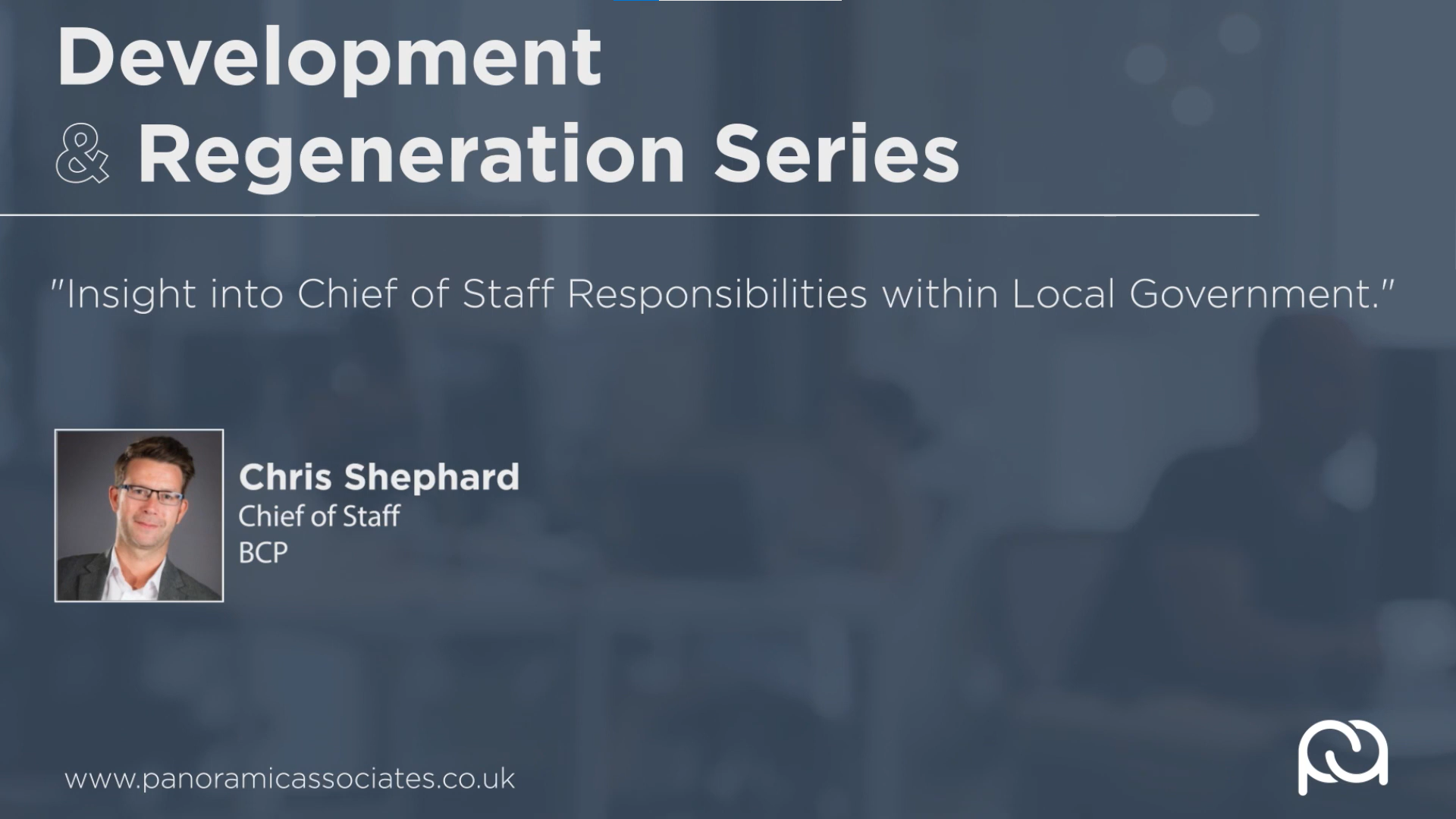
The Development & Regeneration Series – Insight into Chief of Staff Responsibilities

Written by:
Alex Miller,
Lead Business Manager
In the latest instalment of The Development & Regeneration Series, Panoramic Associates’ Practice Director Alex Miller was joined by Chris Shephard, Chief of Staff to the Chief Operating Officer for BCP Council.
Chris has been with the Council for 9 years working his way up to Director of Economic Development as recently as May 2023. He and the Council decided to create and appoint Chris as their Chief of Staff to provide day-to-day support for the current Chief Operations Officer, Jess Gibbons.
In the interview below, Chris covers the logic behind this appointment along with many other current talking points for the Council:
– Where BCP is on the map, and what does the area consist of?
– What the role of a chief of staff consists of in Local Government?
– What benefits of a chief of staff being within an organisation?
– What do you specifically like about the role?
And lots more.
It was an insightful session sharing our views on the topic; it was also an environment to discuss innovative ideas that can be implemented in their respected fields.
Watch the meetup below.
We, at Panoramic Associates, thoroughly enjoy getting insights into our specialist market sectors, other organisations and perspectives. We run these events to build our collective knowledge and provide opportunities to create a network of like-minded individuals.
If you would like to get in involved in future events, or if you have any suggestions on future topics, please contact Alex at [email protected]
Contact our
Specialist Hiring Teams
Panoramic Associates have dedicated hiring experts who specialise in their chosen market. Use the adjacent form to contact our team about your career ambitions or hiring requirement.